
SubmitHub has spent a decade dismantling one of the music industry's most frustrating paradoxes: that the people making the most interesting music are often the least likely to be heard.
WORDS: LILY NGUYEN

In 2015, Jason Grishkoff had a problem. The South African entrepreneur - a former Googler who had left the Googleplex in 2013 to run his music discovery blog Indie Shuffle - was receiving upwards of 300 artist pitch emails a day. He couldn't respond to all of them. Most artists heard nothing back. His solution was characteristically engineer-brained: don't complain about the process, build a better one.
SubmitHub launched in October 2015 with a deceptively simple premise. Artists pay a small fee to send their music directly to curators - playlist owners, bloggers, YouTube channels, radio hosts, record labels. In return, those curators are obligated to listen and respond. More than a decade on, the platform has processed tens of millions of submissions, approved and shared over 3.85 million songs, and established itself as a permanent fixture in the independent artist's toolkit.
The Problem SubmitHub Actually Solved
Independent artists seeking coverage before SubmitHub had two options: spend days crafting cold-email pitches to editors under no obligation to reply, or pay a traditional PR firm thousands per campaign with no transparency about where the money went. Neither was built for the artist.
SubmitHub flipped the dynamic. The platform's credit model - where artists purchase credits and curators earn a portion of each credit they respond to - created mutual accountability that simply hadn't existed before. Curators had a financial and reputational incentive to engage seriously. Artists got something they'd almost never had: a guaranteed response, and with premium submissions, written feedback within 72 hours regardless of the outcome.
That written feedback became one of the platform's most distinctive value propositions. For an unsigned artist releasing music without A&R access or a management team, receiving honest notes from a music blogger in Berlin or a playlist curator in São Paulo isn't just emotionally useful - it's actionable intelligence about where their music sits in the market.
Note: Direct pitching still plays a role in 2026. Our guide to the top music blogs for independent artists covers the outlets where those pitches land.
Premium credits currently cost in the region of $0.80 to $1 each, making a meaningful campaign of 50 to 100 targeted submissions achievable for under $100. That is a materially different proposition than a traditional PR retainer.
Critically, the platform is genre and profile agnostic. Grishkoff has noted that curators respond to what's in their feed that day - tracks submitted by major-label PR teams sit alongside those from first-time self-releasing artists, evaluated on the same terms. A well-targeted SubmitHub campaign has helped artists rank above established acts in genre charts, proof that the platform's mechanics genuinely reward craft and strategy over promotional muscle.
SubmitHub is routinely cited in artist development conversations at independent labels and management companies. It appears consistently in recommendations from music marketing professionals and specialists across genres - from LANDR and Symphonic to genre-specific educators working in jazz, metal, electronic and beyond. That consistency of recommendation in a sceptical, crowded market reflects something real: a user experience that, when approached strategically, delivers on what it promises.
The caveats are real too, and the platform doesn't hide them. Acceptance rates vary - site-wide figures range from roughly 5% for standard submissions to north of 30% for well-targeted premium campaigns. No platform can make a song connect with an audience that isn't there. SubmitHub works best for artists who treat it as a system to be understood, not a machine into which tracks are fed in bulk.
That expectation-setting is, in itself, a reflection of the platform's character. Grishkoff built SubmitHub to do one thing well: make the relationship between artists and curators honest, efficient and mutual. The music business has always needed more of exactly that.

Everything independent artists, publicists and labels need to know about the platform — how it works, who it serves, and why it has become a fixture of the modern release campaign.
SubmitHub is an online music submission platform that connects independent artists, publicists and record labels directly with music curators - the bloggers, playlist owners, YouTube channel operators, radio hosts, TikTok creators and industry professionals positioned to promote and champion new music.
Founded in 2015 by Jason Grishkoff - a South African entrepreneur, former Google employee and founder of the music discovery blog Indie Shuffle - the platform was built to solve a problem Grishkoff encountered first-hand: the complete breakdown of the submission process between artists seeking coverage and curators drowning in unsolicited pitches.
SubmitHub replaced the cold-email free-for-all with a structured, accountable system. Artists submit music using a credit-based model; curators are obligated to listen and respond. The result is a two-sided marketplace with genuine accountability built into the mechanics on both sides.
Today, more than one million artists, publicists and labels have used SubmitHub to promote their music, and over 3.85 million songs have been approved and shared through the platform's network of 1,800+ quality-checked curators.
1. Create a profile and upload your track Artists sign up, build a profile - including biography, social links, press photos and streaming connections — and upload the track they want to promote. The platform's AI-assisted genre detection tool can analyse the track and suggest the most relevant genre tags, improving targeting accuracy from the outset.
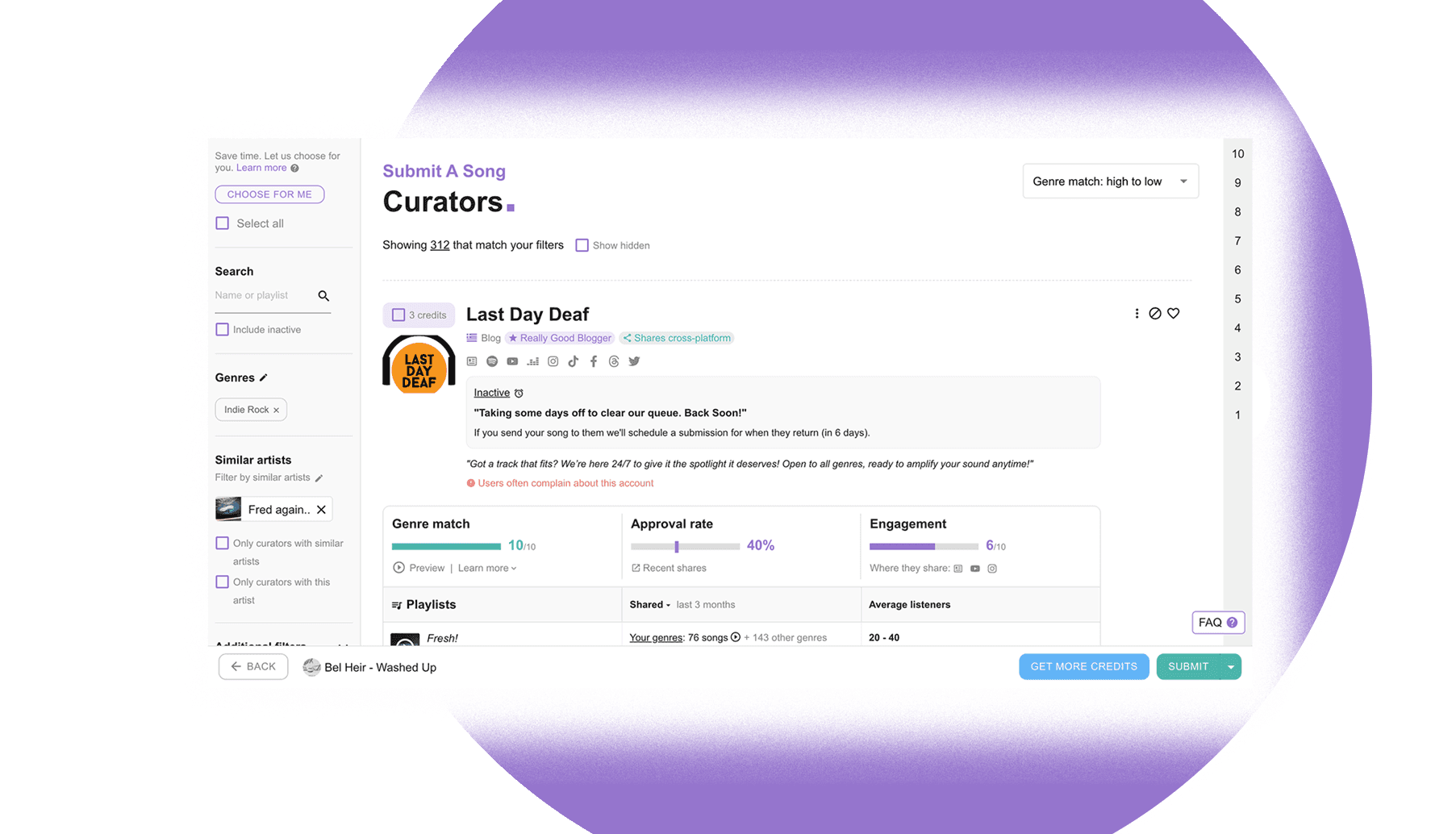
2. Browse and filter curators SubmitHub provides detailed data on every curator in its network: genre preferences, approval rates, average audience size, recent sharing activity, response quality scores, and the types of outlet they represent. Artists can filter by genre, platform type, follower count and acceptance rate to build a targeted list of curators genuinely likely to engage with their music.
3. Submit using credits Submissions are made using credits - the platform's currency. There are two tiers:
Standard (free) credits - No cost, but curators are under no obligation to respond, and response rates are substantially lower.
Premium (paid) credits - Typically $0.80 to $1 each, with bulk discounts available. Premium submissions guarantee a response within 72 hours, require the curator to listen for a minimum of 60 seconds, and mandate written feedback regardless of whether the track is accepted or declined. Unused credits are returned if a curator fails to respond within the window.
Each curator sets their own credit cost per submission, typically between one and four credits, reflecting the size and engagement of their audience.
4. Receive feedback and coverage If a curator declines the track, the artist receives written feedback explaining why - specific, original commentary that copy-paste responses are prohibited by the platform. If the curator approves, they confirm when and how they plan to share the track, and both parties can communicate directly about the release details.
SubmitHub is used by a broad spectrum of music industry participants, but it is designed primarily around the needs of those who don't have a traditional promotional infrastructure behind them.
Independent artists - Musicians self-releasing music who want a structured, affordable mechanism for getting their work in front of curators, without needing a PR firm, manager or label backing. SubmitHub is particularly well-suited to artists at the early-to-mid career stage who are building their promotional toolkit for the first time.
Independent labels - Smaller labels and imprints that release music without the marketing budgets of major-label affiliates use SubmitHub as a cost-effective component of their release campaigns. The platform's filtering tools allow labels to run targeted campaigns across multiple genres and outlet types simultaneously.
Publicists and music marketers - PR professionals managing campaigns for developing artists use SubmitHub to supplement traditional outreach, reach niche curators that conventional press lists miss, and generate data about how a track is landing with different audience segments before wider promotional pushes.
Artists testing new material - Given the speed of feedback - most premium responses arrive within 24 to 72 hours - SubmitHub has become a useful testing environment for artists and producers who want to gauge how a track is received by informed listeners before committing to a wider release strategy.
The breadth of SubmitHub's curator network is one of its most significant differentiators. Unlike platforms that focus exclusively on Spotify playlist pitching, SubmitHub spans the full promotional ecosystem an independent artist needs to build genuine visibility.
Curator types accessible through SubmitHub include:
Music blogs and online publications - Including established editorial outlets that use SubmitHub to manage their submission intake
Spotify playlist curators - Independent playlisters across all genres, with follower counts ranging from hundreds to hundreds of thousands
YouTube music channels - Discovery channels that champion new music to engaged subscriber bases
Apple Music curators - Playlist owners operating within the Apple Music ecosystem
TikTok and Instagram influencers - Social creators who feature and promote new music to their audiences
SoundCloud repost channels - Community-led accounts that surface new tracks to SoundCloud's active listening community
Online radio stations - Independent broadcasters programming new music for dedicated audiences
Independent record labels - Labels actively using the platform for A&R discovery and demo intake
This multi-surface reach means a single well-planned SubmitHub campaign can simultaneously generate blog coverage for the EPK, playlist adds for streaming algorithm momentum, YouTube features for discovery, and label attention - outcomes that would traditionally require separate outreach campaigns, separate budgets, and separate relationships.
Guaranteed engagement, not guaranteed placement. Unlike pay-for-play services that promise coverage in exchange for payment, SubmitHub sells access and accountability. Premium submissions guarantee that a curator will listen and respond - what they say is determined entirely by the music itself. This distinction matters both ethically and practically: coverage earned through SubmitHub is authentic, credible and attributed to actual curatorial judgement.
Radical pricing transparency. Campaign costs are entirely within the artist's control. A meaningful test campaign - 25 to 40 targeted premium submissions - can be run for between $25 and $80. Larger campaigns of 100 submissions typically cost between $80 and $120 with bulk credit pricing. There are no retainers, no minimum spends, no hidden fees, and unused credits roll over or are refunded when curators don't respond.
Actionable feedback at every stage. Every declined premium submission comes with written curator notes. Over the course of a campaign, this feedback accumulates into a meaningful dataset about how the track is landing - which elements are resonating, which aren't, what the genre positioning looks like from the outside, and what adjustments might strengthen the next release or pitch.
Data-driven curator selection. The transparency of SubmitHub's curator profiles - showing approval rates, recent sharing history, audience metrics and genre match scores - means artists can make informed decisions about where to invest their credits. A curator with a 3% approval rate and 200 followers is self-evidently a different proposition to one with a 25% approval rate and a playlist of 15,000 engaged listeners.
A level playing field. SubmitHub's mechanics are designed to evaluate music rather than reputation. Curators respond to what's in their submission feed on a given day - tracks from independently released artists sit alongside submissions from established acts and major-affiliated PR teams, and both are considered on the same terms. Strategic targeting and track quality are the primary determinants of success.
Platform credibility for press and EPK use. Coverage generated through SubmitHub - blog features, playlist adds, reviews -carries genuine credibility because it reflects real curatorial decisions. A strong set of SubmitHub results is usable as supporting material in an electronic press kit, booking pitch or label approach.
Is SubmitHub legitimate?
Yes. SubmitHub is one of the music industry's most established independent promotion platforms, in operation since 2015 and used by over one million artists, publicists and labels. It is regularly referenced by music industry publications and recommended by independent label A&R professionals, music marketers and artist development advisors.
What is a realistic acceptance rate on SubmitHub?
Acceptance rates vary significantly depending on genre, targeting strategy and track quality. Site-wide figures across different reporting periods have ranged from approximately 5% for free standard submissions to north of 30% for well-targeted premium campaigns. Artists who research curators carefully, target for genuine genre fit, and submit with a personalised pitch note consistently outperform those who submit broadly without strategy.
Can I use SubmitHub before my track is released?
Yes, and it is often recommended. Artists can submit unreleased or privately shared tracks. The 72-hour feedback window on premium submissions means a campaign can be run in the days immediately preceding release, with coverage going live around or shortly after the release date. Some artists run a small test campaign two to three weeks before release to gather feedback that can still be acted on.
Is SubmitHub only for Spotify?
No. While Spotify playlist pitching is one of the most common use cases, SubmitHub's curator network includes blogs, YouTube channels, Apple Music curators, TikTok creators, SoundCloud channels, radio stations and independent record labels. Artists can filter the network by outlet type and focus their campaign on whichever surfaces are most relevant to their goals.
What genres does SubmitHub cover?
All major genres and a significant number of specialist subgenres. The platform's genre-matching system allows artists to tag their music with up to three genres and a range of mood descriptors, and curators similarly tag their outlets and playlists. Genre coverage spans pop, rock, indie, hip-hop, R&B, electronic, folk, jazz, metal, classical and beyond.
How does SubmitHub make money?
SubmitHub operates on a revenue-sharing model. Curators earn a portion of each premium credit they respond to - typically $0.50 to $1.50 per submission - and SubmitHub retains the remainder. This alignment of incentives ensures that curators are motivated to respond thoughtfully and artists receive the engagement they've paid for.
Visit submithub.com to create an artist profile and begin submitting today.

About The Author
Lily Nguyen is Editor-in-Chief at Hype-Index, where she covers artist development, music marketing and the wider music industry ecosystem.